Wednesday 2nd October, 2024 – Inverness, Fortrose, Chanonry Point, Rosemarkie, Cromarty, Dornoch
Distance driven: 78.0 miles
Time at the wheel: 1 hour 50 minutes
Heiland coos spotted: 0
We were back on a highish mileage day, made more so because the Cromarty-Nigg ferry does not run after September 30th so we’d missed it by a day, a fact the satnav refused to acknowledge without a degree of jiggery-pokery from me. It’s also not something you’ll gather from the woefully inadequate website either. We could probably have simplified the day by not going to Cromarty, but as I now know, we’d have regretted that big time. First, however, we needed to tidy up, repack the car, and check out (leave the key in the key safe) of our accommodation.
What followed was a day with quite a lot packed into it. We wanted to investigate the Black Isle, and Fortrose, a former royal burgh, seemed like a good place to start. We particularly wanted to see the 13th century cathedral which was mostly demolished in the mid-17th century by Oliver Cromwell (him again) because he wanted to supply building materials for a citadel at Inverness. This is a major pity because what is left suggests that the complete building, which replaced the Church of St Peter in Rosemarkie (of which more later), would have been most impressive.
Of course, as the seat of the bishopric of Ross you’d expect something swanky, and the vaulted south aisle with bell-tower (and oddly a modern clock), and a detached chapter house certainly point that way. Apparently the chapter house was used as a toll booth after the Reformation, though I’m not sure how! It was a lovely morning so nosing round the ruins was a real pleasure.

As was a short meander around the high street of Fortrose afterwards, fetching up at the surprisingly on-trend IV10 deli and bistro for a coffee break and a snack.

A cheese scone and a latte were refreshment enough and we were soon on our way to Chanonry Point. Described as “a spit of land extending into the Moray Firth between Fortrose and Rosemarkie”, it’s not easy to access and I imagine in Summer it’s utterly rammed. The car park is on the small side (and not free) and the route through it runs straight through the middle of a golf course. When you get there you are first faced with the lighthouse, which is situated at the tip of the point. It was designed by Alan Stevenson and came into service in 1846. It is now fully automated although there’s a notice outside saying that it’s a private home and that people shouldn’t park across its gates which I suspect is related to the sheer numbers of visitors. And that happens because Chanonry Point is one of the best places in the UK to view dolphins. Unfortunately, wherever the dolphins were this day, they were NOT at Chanonry Point. We saw not a trace of them. We did see several seals at a distance, and a lot of avian wildlife, but of cetaceans, not a trace. It didn’t matter. It was a glorious day, the views were stunning, and we could see Fort George (a fort built in the wake of Culloden in 1746) clearly. Historic Environment Scotland say that “Fort George is the finest example of 18th-century military engineering anywhere in the British Isles, though the army base never fired a shot in anger. Today, the fort would cost nearly £1 billion to build and equip.” It certainly looms large on the horizon from here (and there’s a seal in the foreground if you looks closely).
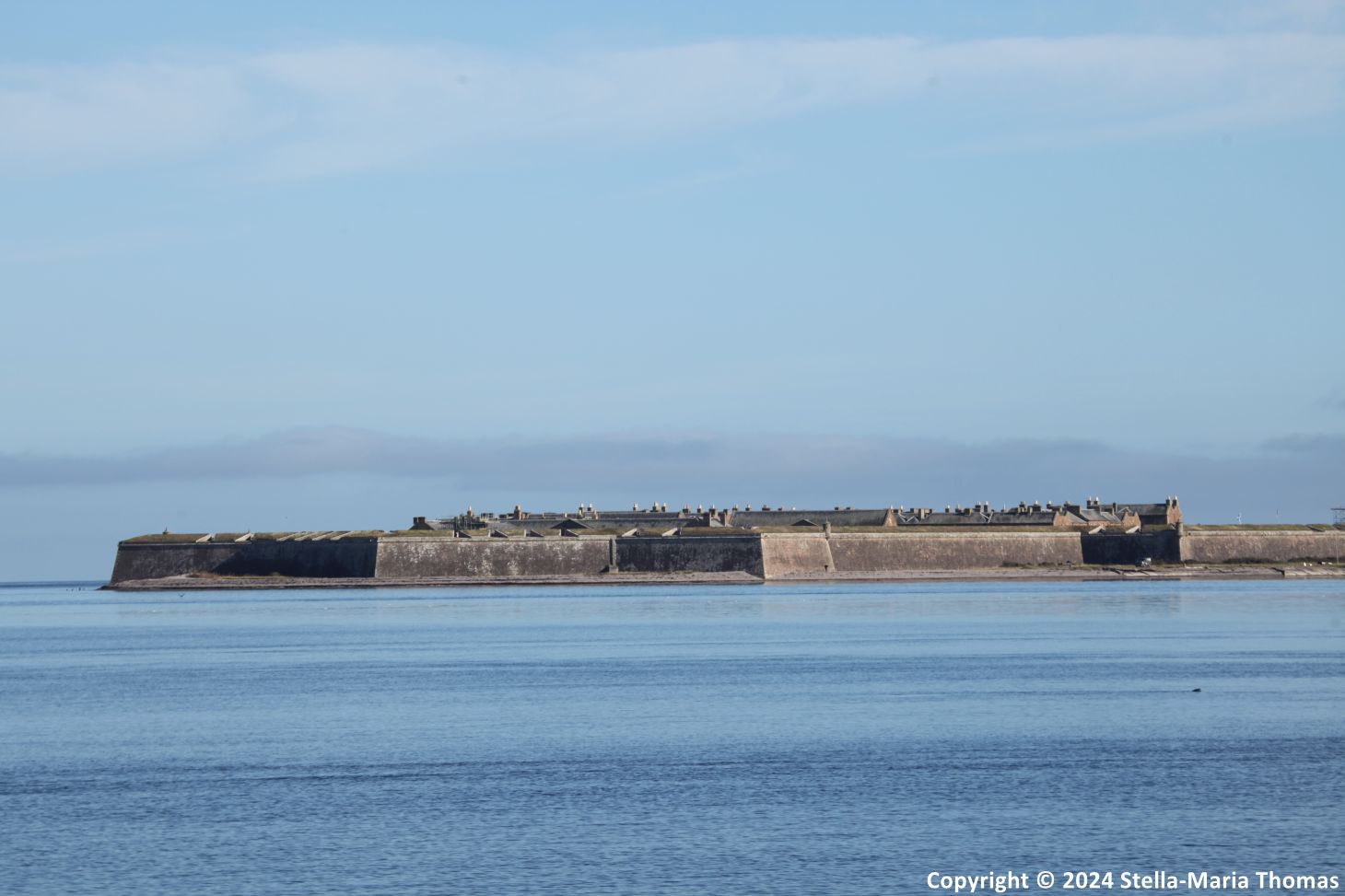
But not one single dolphin…

Once we’d decided the dolphins really weren’t going to show, we moved on along the road to Rosemarkie where we were keen to visit both the church that was replaced by Fortrose Cathedral and the Groam House Museum. We were out of luck with the church because a funeral was just starting, but the museum opened shortly after we arrived, and we happily sat in the sunshine while the unlocked and let us in.

The museum is full of fine examples of Pictish stones, as well as very friendly staff who want to impart as much knowledge to you as you can cope with as quickly as they can! They also have a collection of Celtic art and the George Bain Collection which is an interesting example of more modern artists being inspired by the past.

Just outside Rosemarkie is the Fairy Glen. We parked near the signs, but lack of clarity on the part of the temporary sign that was up meant we never found our way in there. The bridge has been washed away (apparently some while ago) and in fact you need to get there by walking up the other side of the river from the beach at Rosemarkie, not from the car park on the other side of the village (unless you want to have to wade across to the other path). We gave up and drove on to Cromarty.

Cromarty seemed very quiet when we parked up, but turns out to have a lot more going for it than you might think on first sight. It may well have a population numbered in three figures, but it’s a former royal burgh, and was once very prosperous indeed. Like many of the towns we visited on this trip, it had done well initially until herring fishing changed with the advent of larger ships, the shift of the herring migration route, and the shift in shipping to the other side of the Cromarty Firth. Signs of its former prosperity are everywhere with a number of very elegant Georgian buildings. The port was an important British naval base during both World Wars but naturally that was only short term. However, it looks as if tourism has brought some income back to the town, possibly along with people moving out of Inverness looking for a different pace of life but remaining within reach of the main city in the region. It certainly also seems to be a hub of creative activity. It’s got the Cromarty Arts Trust, which restored several buildings in the town, an independent cinema, an annual Crime and Thrillers weekend, a Harp Weekend, and annual exhibitions by local artists. There’s a History Society, a Film Society, and an extremely good Photography Society if the exhibition we saw is anything to go by. There is also, I’m told, a Rowing Club which hosts its own regatta.
We started by visiting Cromarty Courthouse, which is one of those fine Georgian buildings which now contains a museum that has a great deal of information about local life and particularly local justice. It also contained the aforementioned photography exhibition, which made me want to get in touch with the club and ask if I could buy some prints. The only thing stopping me is our lack of wall space that isn’t already occupied by photos!

In the nineteenth century, Cromarty was the birthplace and home of Hugh Miller, a geologist, writer, journalist and participant in the Disruptions in the Church of Scotland. Hugh Miller’s Birthplace Cottage & Museum is next to the Courthouse and is maintained by the Scottish National Trust, so free entry yet again with our English NT cards. I’m only slightly over 5′ 6″ and I had to constantly duck going through the doorways. Miller was apparently well over 6′ and must have had a permanent crick in his neck.

The burgh is noted as a base for viewing the local offshore sea life. These include one of the most northerly groups of bottlenose dolphins. Cromarty, along with Chanonry Point just round the coast, is one of the best places in Europe to see these animals close to the shore. There are a number of other fascinating buildings in Cromarty, both old (the lighthouse) and new (the cinema) but we were now running out of time, and had in any case decided we would come back the following day to go on a wildlife spotting boat trip.
That decision made, we headed to our overnight destination, the fabulous Strathview Lodge, a very comfortable B&B just off the A9 (with the entrance on a fairly sharp bend) where we were soon settled in and admiring the amazing views provided from the patio outside our room. That evening was a much simpler dinner than the night before. We headed the 6 miles into Dornoch to The Castle Hotel and ate Dornoch gin-cured salmon, cucumber, beetroot, and sourdough crostini, and arancini, with taleggio cheese, and tomato and pepper sauce (for starters) and then shared a couple of pizzas, a Local Salami (topped with local venison and pork salami, and oregano) and a Haggis (topped with local haggis, smoked cheddar, and caramelised red onion and fig jam). Service was again warm, friendly, helpful and I would definitely recommend it to anyone who is hungry – we couldn’t finish either pizza and so the wait staff happily supplied us with some kitchen foil to wrap the remaining halves in. We figured we’d eat them at our next self catering venue.

Oh, and the puffin mural on the dining room wall is wonderful.

 Smtfhw's Travels
Another excellent day. On the subject of lighthouses there are no manned beacons left anymore in the UK. A rather sad fact.
LikeLike
I didn’t know that. I agree it’s sad. One of the things I recall from being there as a child was being invited to view a lighthouse, possibly the one at Cape Wrath, by the lighthouse keeper. He pointed out a white whale that had been around for a couple of days.
LikeLike
Nice memory Stella.
LikeLike
There seems like a lot of history in these parts. Thank you for sharing a bit of the local sites. I liked that flower? sculpture at Cromarty.
LikeLike
There is indeed a lot of history and I hope you’ve found some of what’s in the post helpful. The flower is in the grounds of Hugh Miller’s Birthplace Cottage & Museum.
LikeLiked by 1 person