Friday 4th October, 2024 – Dornoch, Golspie, Helmsdale, Thurso
Distance driven: 64.0 miles
Time at the wheel: 1 hour 19 minutes
Heiland coos spotted: Still defiantly 0
We were on the move again so said goodbye to Strathview Lodge, though not before sampling their full Scottish breakfast.
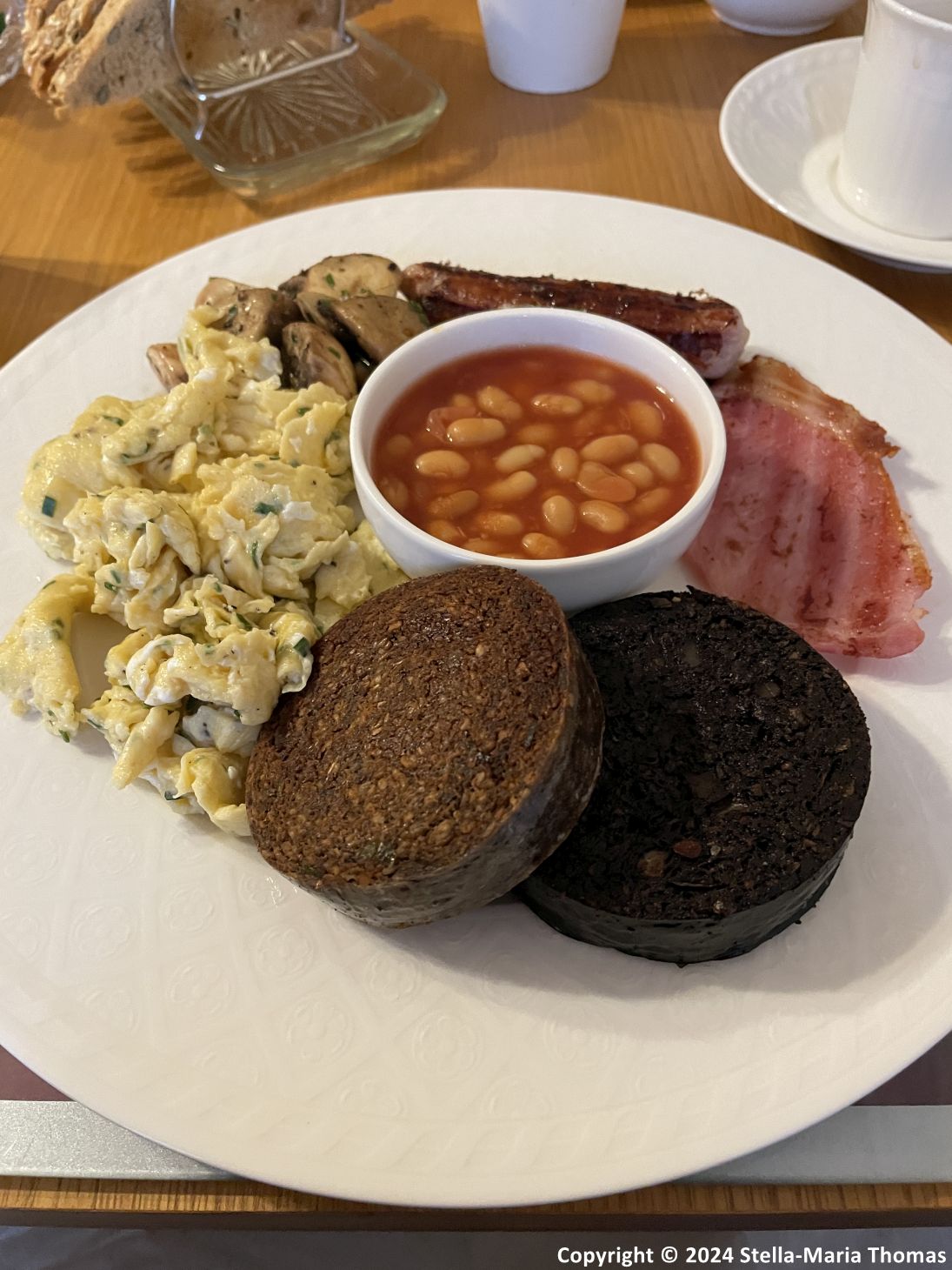
I would certainly recommend them as a place to stay that’s comfortable, has stunning views, and where they feed you well. The weather was looking a bit temperamental as we set off to see what we could find of interest today. The first thing that caught our eye was a car parking area just off the A9 which turned out to be the Mound, on a stretch of the previous road. “The Mound, built in 1814-16 to plans drawn up by Thomas Telford, is an embankment with a bridge at the northern end, spanning the mouth of Loch Fleet. The bridge is the most northerly section of the mound, and is overshadowed by the new A9 bridge. It is both beautiful and unusual in form, incorporating non-return valves in the form of wooden flaps. Small stone buildings on each side house winding-gear to raise some of the flaps so as to allow the passage of fish. The posts upstream of the bridge are intended to protect it against floating debris and ice-floes. The Dornoch Light Railway crossed the bridge between 1900 and 1960.” It seemed very peaceful, and is a place where wildlife of varying types can now be spotted. We were impressed by the idea that it could be adjusted to let salmon through. However, unless we planned to go wading around the estuary, we weren’t able to investigate much further. Mostly, we saw herons.

From there we made our way to Golspie where we stopped for a nose around. It seems like an interesting enough little place, and it certainly had some useful facilities, including some very decent public toilets in one of the car parks. We had a walk along to the harbour, and back, and after collecting some supplies in a couple of the local shops, we continued on, arriving at our next stop just as they opened for the day.

The destination in question was the frankly bonkers Dunrobin Castle, all 189 rooms of it, just outside Golspie. Imagine that someone has taken a castle from the Loire Valley in France and simply deposited it on the east coast of Scotland, overlooking the Dornoch Firth, and you’ll get some idea of what you’re going to encounter. The current building which was built between 1835 and 1845 is the statliest of stately homes, and is the family seat of the Earl of Sutherland, Chief of the Clan Sutherland. The family has been here a long time, but at some point the second Duke of Sutherland called in the architect Sir Charles Barry to do a renovation of the existing property. It’s fair to say that the architect, who had previously worked on the Palace of Westminster, seems to have got a bit carried away! The 14th-century tower, and some 17th and 18th century extensions remain but are tucked away in what resulted from the Grand Design to end all Grand Designs. You will also not be surprised to know that three decades later the family had their own railway station, opened in 1870 as a private station for the castle. The interior was inadvertently remodelled again after a fire in 1915, and was then restored by architect Sir Robert Lorimer, who altered the top of the main tower and clock tower at the north side of the building to the Scottish Renaissance style.
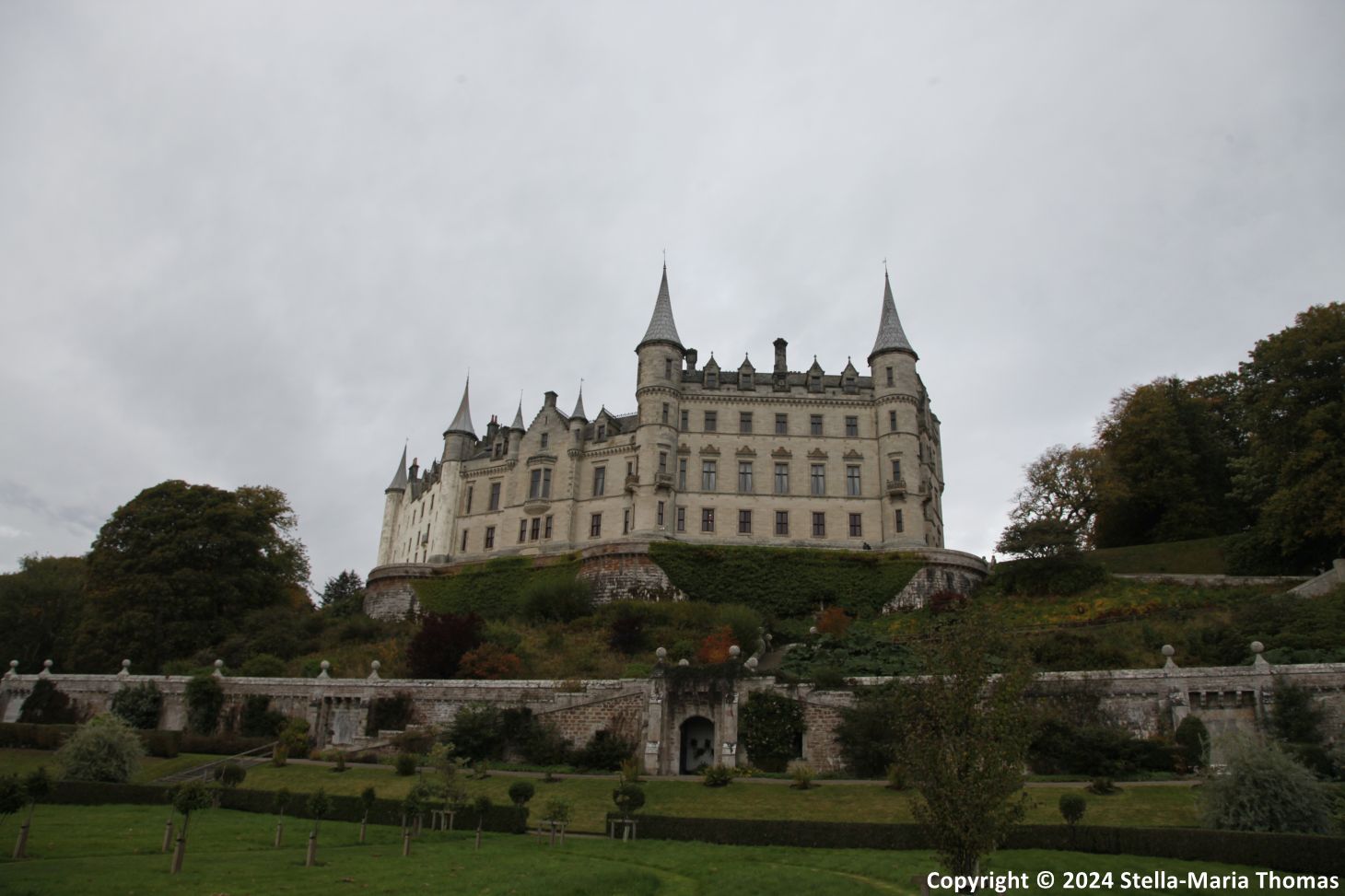
On arrival we were pleased to discover that the twice daily falconry displays had not in fact stopped at the end of September and we were just in time to take a short stroll around the stunning gardens before the next display started. It was a very informative session and I certainly learned a lot about hawks and falcons, and the difference between them (hawks work together, falcons don’t being the main difference). The gerfalcon, Alba, was a particularly stunning creature.

Afterwards, as were down in the garden and there were a lot of steps involved in going back up to the house, we decided it made sense to visit the private museum in the grounds. It contains more Pictish stones but also an absolute menagerie of stuffed animals, birds and fish. If the house is bonkers, the museum is frankly demented. There’s a sign outside warning people that they may find some of the exhibits upsetting, and I suspect they’re not wrong. There are also some unfortunate souvenirs of the colonial past that definitely display attitudes that would offend most sane people. Lynne did wonder briefly if the staff on the estate kept moving at all times to avoid being shot and sent off to the taxidermist! It was startling to say the least.

From there we dragged ourselves back up the stairs, cursing most of the way, and decided that we’d better stop for coffee before tackling the house. Around 20 of the rooms are open to the public though it felt like a lot more and there was a great deal to take in between the paintings, the objets on display, and the history scattered throughout (including an early fire alarm system!). There were a lot of people there for a grey mid-week day in early October, and I can see why. It was fascinating even if I could be heard to mutter that it was proof that crime does pay.

Several hours after we arrived we were finally done with Dunrobin. The plan for the day had always been relatively loose with just the end destination set in stone. We’d considered completing the leg of the NC500 to Thurso by taking in Duncansby Head and John O’Groats, but there wasn’t a great deal of time left to visit anything. Instead we stopped in Helmsdale for a look at the Timespan Museum and Gallery. This is another multi-use institution offering a local history museum, a contemporary art programme, a youth library, a geology and herb garden, a shop, and a café. In other words it’s all things to all people. The exhibition “We Move As A Murmuration” that was on but was in its final days, proved equal parts inspiring and baffling. There was also a lot of local history, mostly around the effects of the Clearances on tenants forced to become fishermen because the Duke wanted to “improve” their lives (and rent the land out to already-rich farmers who were now raising sheep), and what happened to people who were now crofters when the herring was overfished and they could no longer make a living.

By the time we had finished, we were definitely too late to see anything else, so it became a matter of heading for Thurso promptly. It meant we had to stick to the A9 instead of our intended route up the A99 and skip a big chunk to expedite our arrival in Thurso at our AirBnB. The route cuts across the Flow Country, a vast peat bog covering 4,000 km2 (1,500 sq miles). It’s bleak out there and very brown at this time of year. There’s also a railway line running all the way from Wick to Thurso, which caused quite a lot of lamentation from both of us, given there used to be a railway station where we live but because of Dr. Beeching, there isn’t anymore.
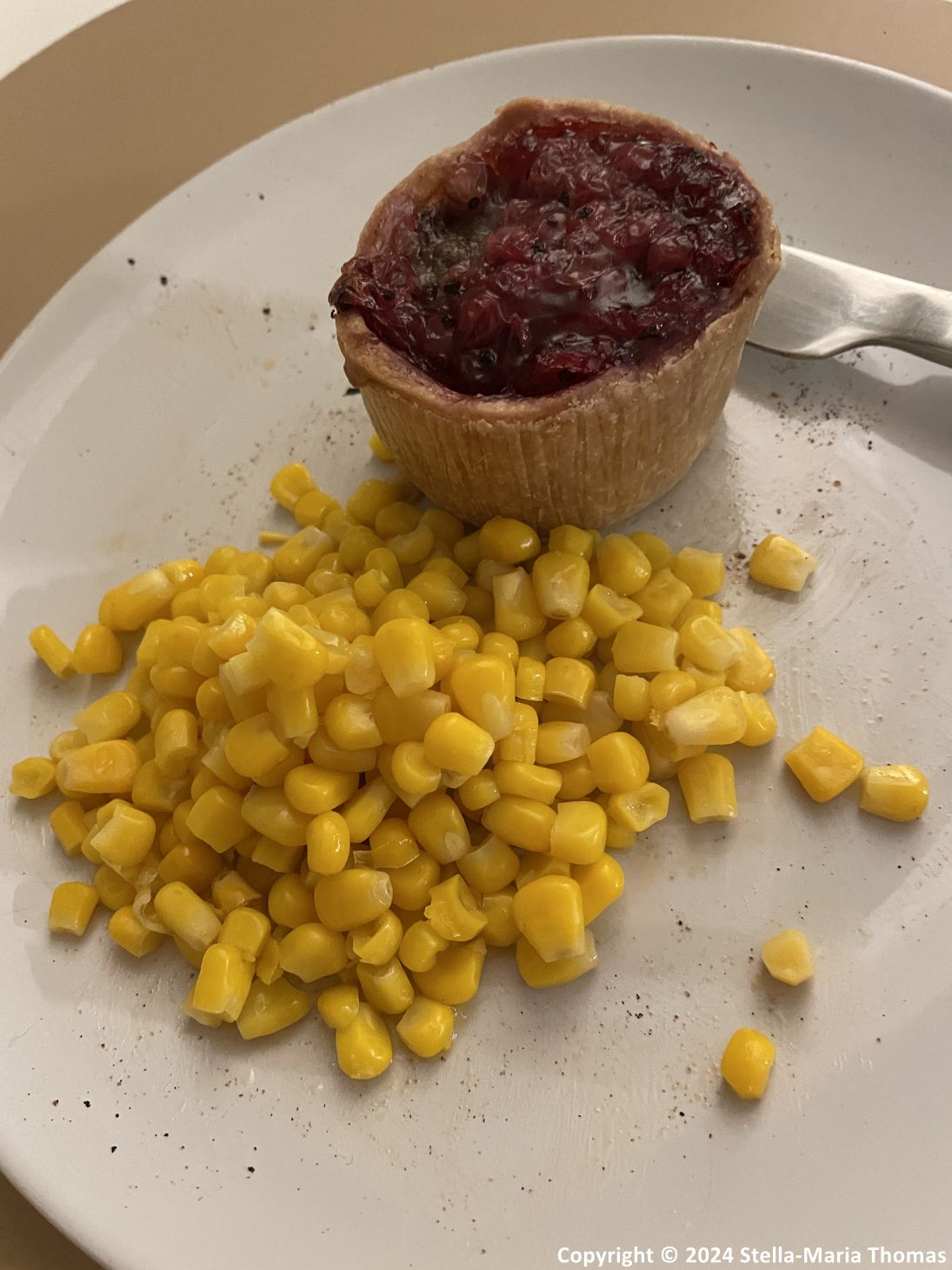
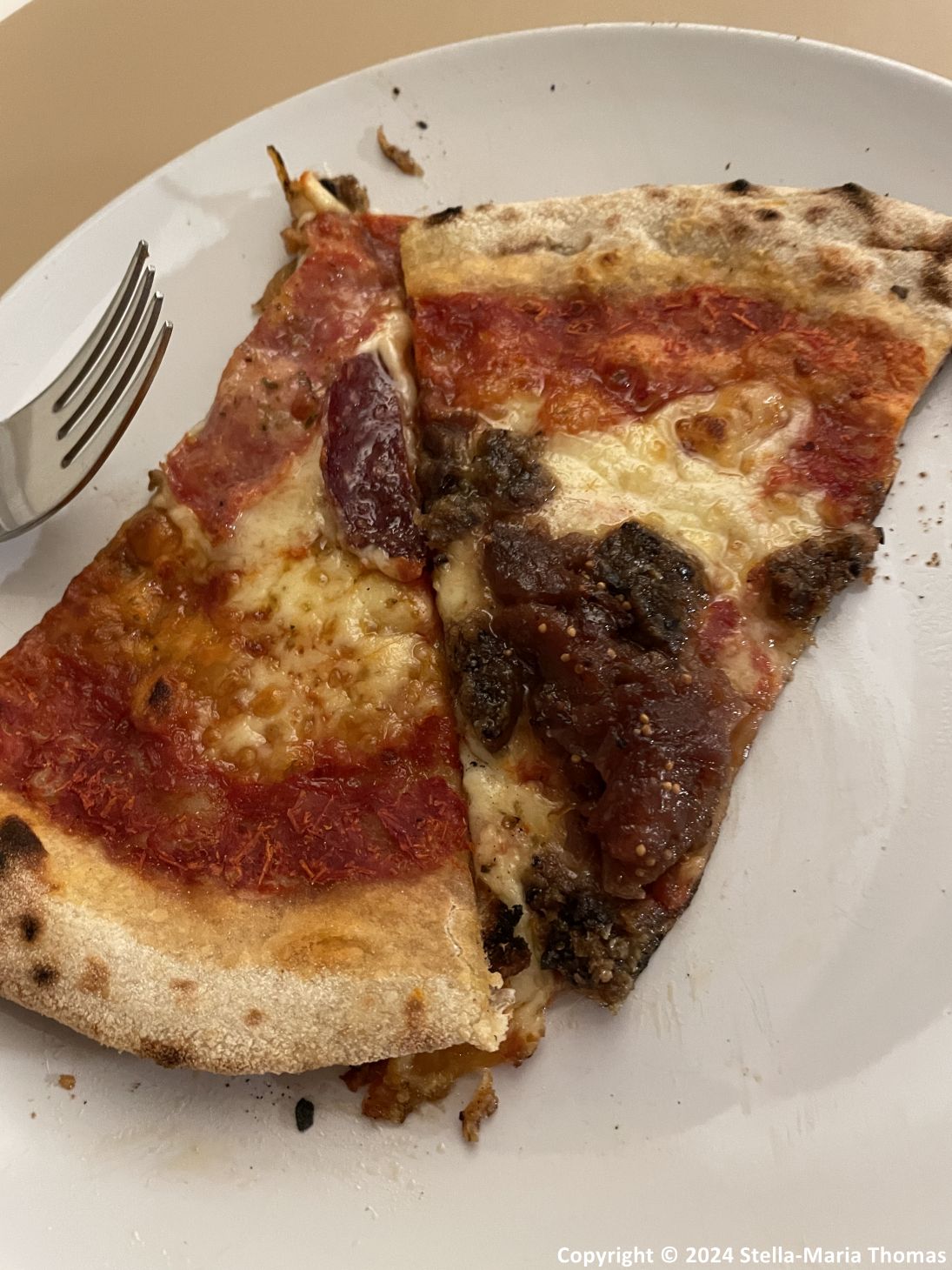
We quickly located our accommodation and settled in to a night in, with leftover pizza from the Dornoch Castle hotel, and a venison pie from Tebay services. We know how to live!

 Smtfhw's Travels
Stunning castle. The breakfast looks good but needed some Scottish potato cake and the egg looks odd. I do like beans in a separate pot I have to say. Venison pie looks good also but not sure about the left over pizza.
LikeLike