Thursday 10th October, 2024 – Gairloch, Kinlochewe, Lochcarron, Strome Ferry, Applecross, Sheildaig
Distance driven: 110.0 miles
Time at the wheel: 3 hours 43 minutes
Heiland coos spotted: 0
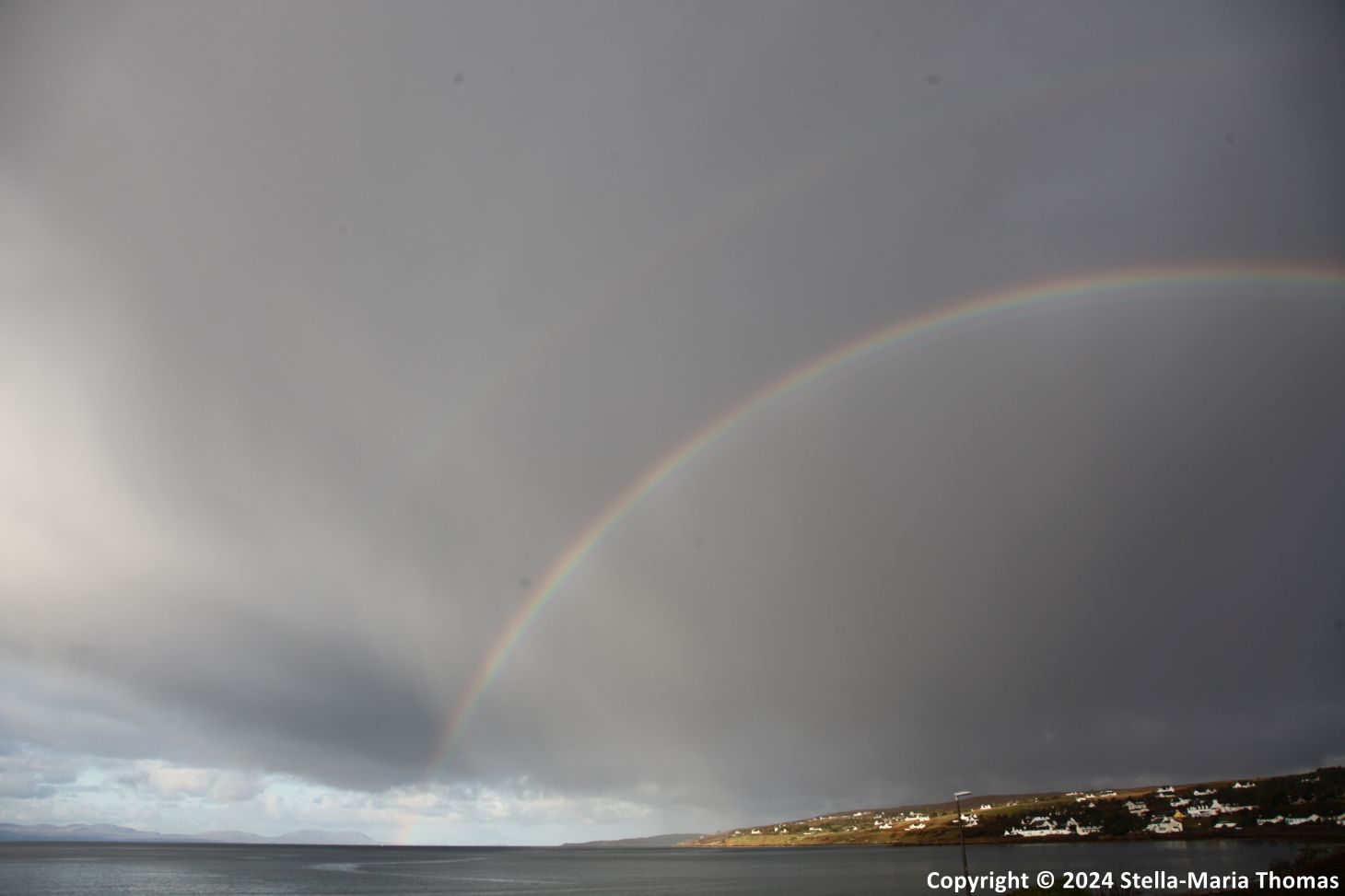
After the storms that rolled through overnight, the temperature had dropped significantly and there was snow visible on the higher ground. The weather was still wildly variable, with sudden squalls hitting seemingly out of nowhere. It did mean there was a magnificent rainbow.
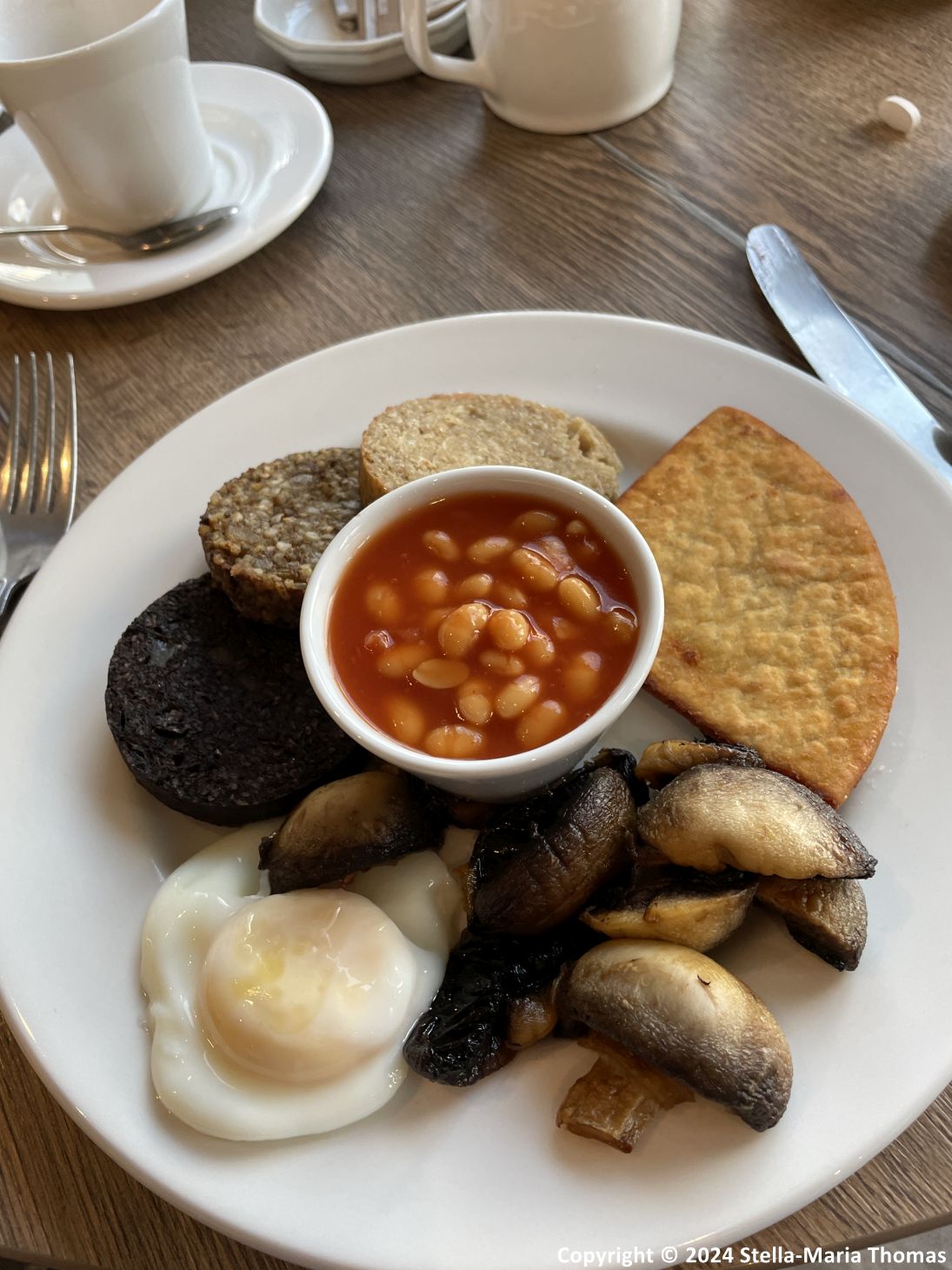
Anyway, we readied ourselves to leave the Myrtle Bank Hotel by indulging in one of their full Scottish breakfasts, which meant we wouldn’t need to worry about eating for the rest of the day. As we’d be heading off into the really wild parts of the region, it seemed like a good idea to eat while we could.
And so, packed up, we headed towards our final destination in Scotland, but first we had some more excitement to experience. We took the road from Gairloch to Kinlochewe, but it wasn’t long before we had to stop to look around. The distraction came in the form of the Beinn Eighe and Loch Maree Islands National Nature Reserve, the UK’s very first national nature reserve. In the glorious sunshine that had broken out it looked particularly stunning.
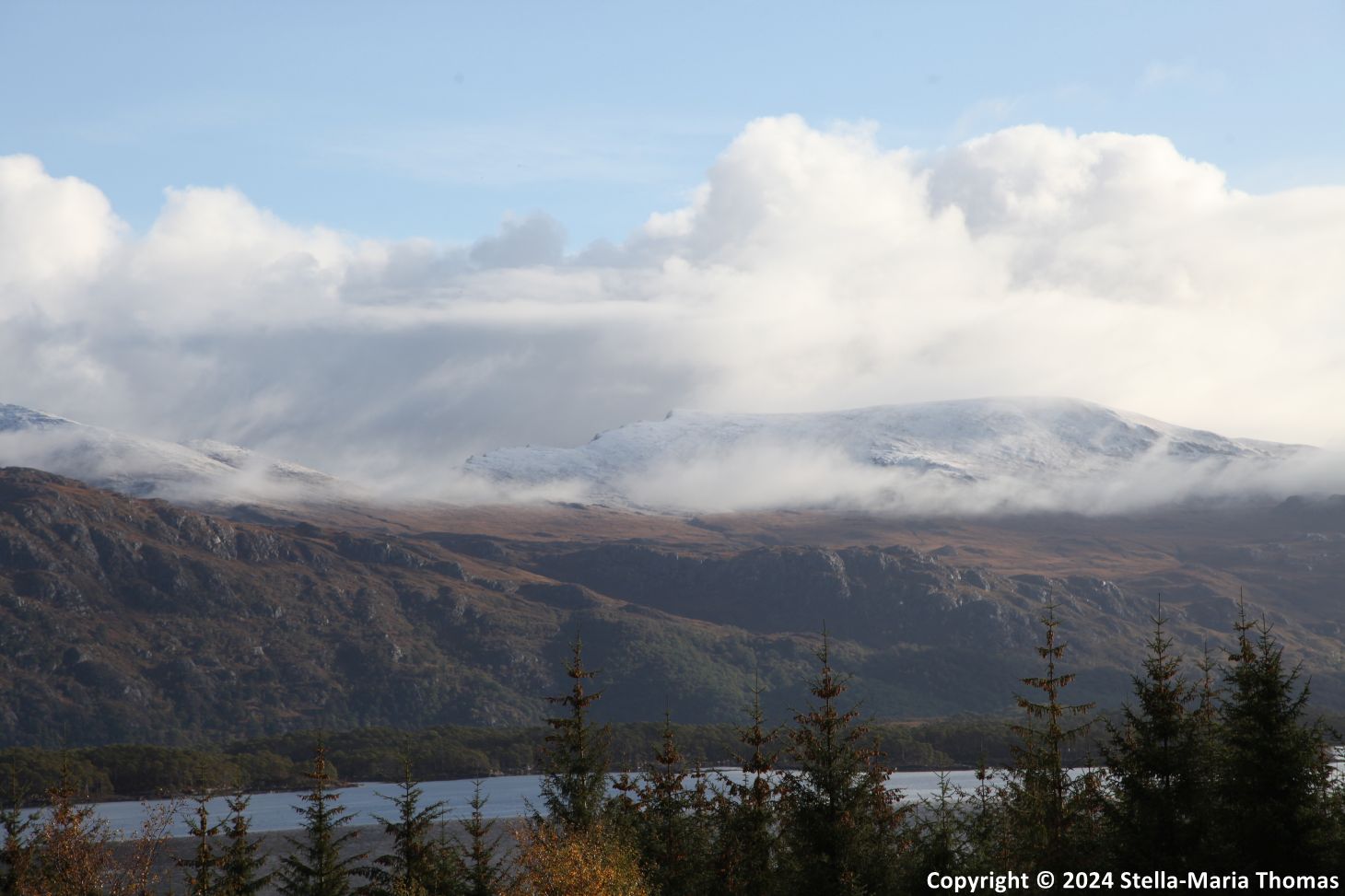
The informative boards scattered around the car park told us that once the whole area had been completely forested. It certainly isn’t any more apart from in patches. There is still some of the ancient Caledonian pine forest living on here, and some of the pines on the Glas Leitir are known to be more than 350 years old. We didn’t see any of the wildlife during our stop, though we did see red deer along our route later in the day (and we definitely heard them). Of the pine martens, eagles, crossbills and divers that also live there, not a sign. It’s as if the wildlife is deliberately avoiding us.

As we moved on, the weather deteriorated again so we took a quick coffee stop at Lochcarron, in The Lochcarron Hotel which overlooks Loch Carron (I love the way place and business names work around here). It was a pretty decent coffee. As we set off again we once more got distracted, to the utter frustration of the satnav which was locked into yelling “turn around when possible” at me by now. This time the distraction was caused by a National Trust for Scotland sign pointing to Strome Castle. It couldn’t be far away so we figured we’d go and have a look. There’s not a great deal of the castle left, and the history books are also remarkably terse on the subject. The NTS doesn’t even give it its own page. Canmore, which “contains more than 320,000 records and 1.3 million catalogue entries for archaeological sites, buildings, industry and maritime heritage across Scotland” is almost monosyllabic on the subject, saying only “15th century tower and hall house; hall altered in length over following century and final construction of tower was 16th century. Tower destroyed in 1602 blast,” and that’s after a 1995 partial excavation.
Digging further, it turned out that the castle was built in in the 1400s, positioned to guard the north side of the Strome Narrows near the mouth of Loch Carron where there was until not that long ago (1970) a ferry crossing. It’s in one hell of a commanding position and from what’s left looks like it would have been a tower house. It kept changing hands and was eventually given to the Macdonalds of Glengarry by King James V in 1539. The Macdonalds spent the rest of its existence fighting off their neighbours, the Mackenzies of Kintail. The whole affair boiled over in 1602 when Kenneth Mackenzie, Lord of Kintail, besieged the place. It seems that the siege ended when some of the Macdonald women accidentally poured water into the castle’s gunpowder barrel. In the resulting row about what had happened, one the Mackenzies who had been imprisoned in the castle escaped and reported what he’d heard. Kenneth Mackenzie knew that the castle was defenceless, the Macdonalds negotiated surrender and safe passage, and then the Mackenzies, possibly having had enough of all this nonsense, blew the place up, which is why there’s not much of it left. But the views from the site were among the most glorious we’d seen, with sightlines all the way to the Isle of Skye.

We set off again towards the drive we’d always planned to do today, the infamous Bealach na Bà which for a long time was the only road linking Applecross to the rest of Scotland. It runs from near Kishorn for 11.1 miles (17.86 km ) and rises to a height of 2053ft (625.7 metres) through a series of hairpin bends that require all your concentration. Do not stop in the passing places to take photos, by the way. There is no need to do so. There are several parking spots with information boards, a nice little pavement you can stand on, and mind-boggling views back down the road you just came up. So don’t be an idiot. From the top, the “Pass of the Cattle” winds back down to the Applecross peninsula, passing the peak of Sgùrr a’ Chaorachain. There is an alternative by way of a coast road opened in 1975 for anyone who doesn’t want to – or shouldn’t – drive over the pass, and the sign is not joking when it says it is “not advised” for caravans, large vehicles, or learner drivers after the first mile. We made it across with a lot of reversing into passing places, or simply pulling over into them when I could see a vehicle coming the other way. It took over an hour to get across and I think that was plenty fast enough. I wouldn’t have missed it for the world.

When we finally got back down to loch level it was a pleasure to call into the Applecross Heritage Centre and decompress with a little light history. Applecross isn’t actually the settlement though. The row of houses shown on some maps as “Applecross” is really called “Shore Street” and is known locally as “The Street”. Applecross is the whole of the peninsula, including the settlements of Toscaig, Culduie, Camusterrach, and Sand. It’s also the name of the local estate and the civil parish, which includes Shieldaig and Torridon, with its population of a little over 500 souls. It’s isolated out there even now. We couldn’t see much sign of life and it took us a while to locate the centre. Once we did, it proved to be the tiniest museum we’d encountered on the entire trip. It’s in what was an outbuilding of the old manse and glebe, built in the 19th century and is operated by the local Historical Society and staffed wholly by volunteers. It’s major purpose is to o promote knowledge of local history and culture and it does that very well, explaining the history of the area from begore the founding of the monastery of Applecross by Saint Máel Ruba of Bangor in the 7th century. In amongst all the artefacts is a great short film about peat cutting made by the local primary school’s pupils.

Calmed by all that history, we now just had to tackled the road from Applecross to Sheildaig where we would be staying the night. The road remains mostly single track with some amazing views out to the Hebrides, but there were even stretches where there was enough tarmac to have two cars pass in opposite directions. Mostly we took it slow and steady and enjoyed the wonder of the views.

As the road opened out we realised we must be near Sheildaig which is perched on the side of Loch Shieldaig. This is yet another place that was built to attract families to take up fishing for a living, either through choice or necessity. In this instance there were grants from the Admiralty (wishing to have trained sailors at their disposal in the Napoleonic Wars) for house- and boat-building, but that support faded away after the final defeat of Napoleon. Luckily there had been good herring fishing in and around Loch Shieldaig since Viking times so it was still possible to make a living for the villagers.
Right in the middle of the loch is an Shieldaig Island, which belongs to the National Trust for Scotland since 1970. It is believed that the trees were planted, probably with seeds taken from Speyside, in the mid 1800s, presumably to provide materials for ship-building. The trees now provide a home for a pair of white tailed eagles which could be seen circling lazily overhead, riding the thermals when we arrived. There are also herons, a pair of oyster catchers, pine martins, otters, and divers, most of which we never actually saw – the a pair of herons startled me as I was loading the car the following morning!

There was a strong suggestion that the restaurant at the Tigh an Eilean hotel but we had anyway decided we wanted to eat at The Torridon because we sure couldn’t afford to stay there. We’d seen it on a TV programme and thought it looked like our sort of place. We weren’t wrong.
We were warmly greeted at the door and led into a space that is frankly about as overtly Scottish as you can get without tipping over into kitsch. It started life as Ben Damph House and was built over two decades, completion being achieved in 1887 (hence the name of the restaurant, we realised). The builder was William King-Noel, the first Earl of Lovelace, who married Ada, Lord Byron’s only legitimate daughter. Yes, she was that Ada Lovelace. He was a scientist, an English landowner, and the Lord Lieutenant of Surrey. The couple followed the fashion of the day after Queen Victoria made the Highlands a desirable destination, and built themselves a modest little holiday home(!) Because everything had to be shipped in (literally) by water it must have been quite the undertaking, with the kitchen garden being created using soil brought from Ireland. And everywhere you look there are tributes to Queen Victoria, including in the Drawing Room with its fantastical Zodiac ceiling (Queen Victoria was fascinated by astrology). The result, all these years later, is that you feel cocooned as soon as you arrive, and that feeling continues when you move to the Whisky Bar for a pre-diner drink, and lasts all the way through the meal. All the little details combine to create a comfortably luxurious feel.
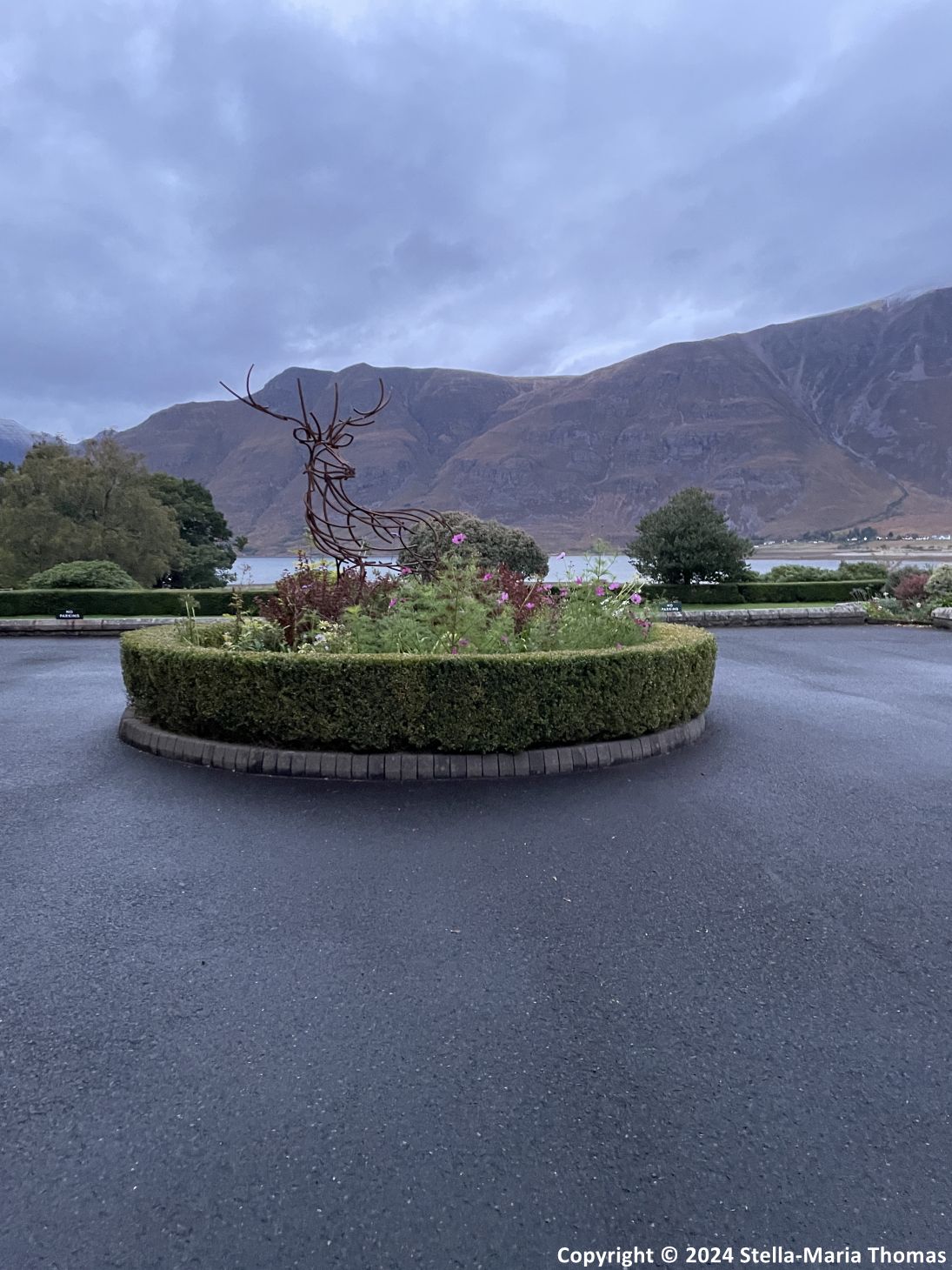
The original entrance was through the Dining Room but then a clock tower was added so you now enter that way and if you’re me I never did get the hang of finding my way from the ladies loos back to the dining room. We had a couple of cocktails in the bar, enjoying the spectacular views out of the window over Loch Torridon, before going through to the 1887 restaurant. We both thoroughly enjoyed the tasting menu and the matching wines that went perfectly with what we were eating.
We had:
- Amuse bouches of:
- Aged Beef Tartare, Cured Egg Yolk, Mustard
- Potato, Pecorino, Summer Truffle
- Pine Cured Trout, Horseradish, Marinated Roe
- Homemade Stout Brioche, Seaweed Cultured Butter
- West Coast Hand Dived Scallop, Yuzu Beurre Blanc, N25 Caviar
- Ross Shire Lamb, Carrot, Parsley, Pickle Mustard
- Solero, Mint basil, Sea Buckthorn
- Valrhona Chocolate, Blackcurrant, Cultured Cream
Oh and we added the Scottish cheese course just because we could!

Full of food we drove back to Shieldaig and were asleep almost before we had time to turn the lights off. It had been quite the final day.

 Smtfhw's Travels
Some great pictures in the gallery Stella.
LikeLike