Monday 7th October, 2024 – Lochinver, Ardvreck Castle, Ullapool, Drumbeg, Clashnessie, Clachtoll, Lochinver
Distance driven: 89.0 miles
Time at the wheel: 2 hours 39 minutes
Heiland coos spotted: 0 (Looks like we’d had our quota)
After a good night’s sleep we decided to set off to explore Ullapool and possibly add another loop of spectacular driving, time and weather permitting. On the way there were some sights we hoped to at least take a quick look at. The first was easy to find as it looms along the side of the A837 and there’s a very handy car park with a couple of the information plaques that are scattered around the parking places on the route. The ruins of Ardvreck Castle, as with most of the castles we saw, stands on a promontory in Loch Assynt. It was built in the 1490s for the Macleods of Assynt and replaced an earlier castle a handful of miles away and is, according to Historic Environment Scotland, “of national importance as an example of a late medieval clan castle”. It had, again as most of the castles, a very chequered history, including in 1650 when James Graham, the 1st Marquess of Montrose, was handed over to the Covenanter forces by MacLeod, Laird of Assynt after the Battle of Carbisdale, although the truth of these events is hard to come by. A generation or so later, Clan Mackenzie attacked and captured the castle and moved in. Half a century later the novelty of living in a 250 year old castle seems to have worn off. In 1726 they moved to the newly built Calda House although they didn’t get to stay there long because the house burned down in 1737. You can see both sets of ruins from the car park, which was just as well because it started to rain heavily as I started to get out of the car.

After that we headed towards Rhue Art Gallery, but after some confusion, we discovered it was close. There was nothing to indicate whether it would be open again anytime soon, so we turned the car around and went back to the main road, wondering as we went precisely what Elphin Chicken Day (which we’d missed by two days) was all about. There were a lot of posters for it…
Before we knew it we were in Ullapool, and looking for something indoors to do while the rain lashed down. With a population of less than 2,000 Ullapool is still a major centre in this part of Scotland. It was founded in 1788 as a herring port by the British Fisheries Society and today is still a fishing port, as well as a yachting haven, and ferry port with sailings to the Outer Hebrides. It’s also now of course a centre for tourism.

We decided that Ullapool Museum would be a good place to start given the weather. That proved to be slightly more difficult than it might normally be because their card machine was refusing to work. A short walk back in the direction we’d come was a branch of Royal Bank of Scotland, with a fully functioning ATM on its outside wall. We extracted cash, went back to the museum, and paid to enter. The building is an original Thomas Telford Parliamentary kirk and is interesting in its own right. Inside, it contains a lot of information about the social history of Lochbroom, particularly with regard to crofting, fishing, and the “Klondykers”. The latter in particular I knew little about so that was interesting. From the 1970s for around two decades, ending in 1989, international fishermen from eastern bloc countries and Africa fetched up off the northwest coast to process mackerel. The locals had responded to the collapse in herring fishing by swapping to mackerel, and these were in high demand, particularly in eastern Europe. The Klondykers arrived in the autumn each year, after the tourists had gone, and would stay for the winter, processing much needed protein for their home countries. At its height in 1985, over 150,000 metric tonnes of mackerel were landed in Ullapool and there was much cross-cultural contact as a result.

The weather had improved slightly, but was still decidedly damp and gloomy. We’d had a coffee earlier so we stopped off in the local deli to buy some haggis and black pudding for when we got home, and then took a slightly soggy stroll along the water front. It was all very pleasant and as the rain eased we decided we really did need to visit the Seafood Shack in search of immediate lunch. Everyone raves about the place and it was soon obvious why. There’s a small pop-up bar on the courtyard so we bought some local cider, and ordered food. The pan-fried scallops with caramelised red onion and wild rice were fantastic and very substantial. I loved the food so much, I bought the cookbook.

As the weather wasn’t getting any worse, we decided that we would leave Ullapool and go and drive the B869, known as the Drumbeg Loop (or perhaps more accurately, the Wee Mad Road). To call it challenging would be about right. There are some genuinely challenging hairpin bends, but the real issue that I found were the blind summits where you really have no idea where the road goes afterwards. It’s a 20 mile loop from the start to Lochinver and took at least an hour to complete, not helped by a ravine where eight of the local sheep decided that rather than getting out of the way, they would simply amble down the road in front of me. It took some time for them to lose interest in this game and finally take themselves off the tarmac and onto the grass at the sides. Freed up, we next encountered a very grumpy looking black goat standing glaring at the oncoming traffic. He did move as we got closer. We stopped off in Drumbeg where there’s a convenient viewpoint and parking area (and good public toilets – there seem to be a lot of these along the NC500). We also stopped at Clashnessie Bay, which was lovely but very wet. All in all it was incredibly beautiful, and I’d now had some practice on genuinely challenging roads so would be ready for what came next.

Back in Lochinver it was time to tidy up and head out for dinner at Delilah’s. This proved to be an excellent choice because a) it was an easy walk from the AirBnB and b) the food and service were really good. I also made a canine friend during the evening. Everything we ate was locally sourced from the scallops and the squid starters to the halibut and the lobster and chips (which were really good, worth the trip for that dish alone I would say).

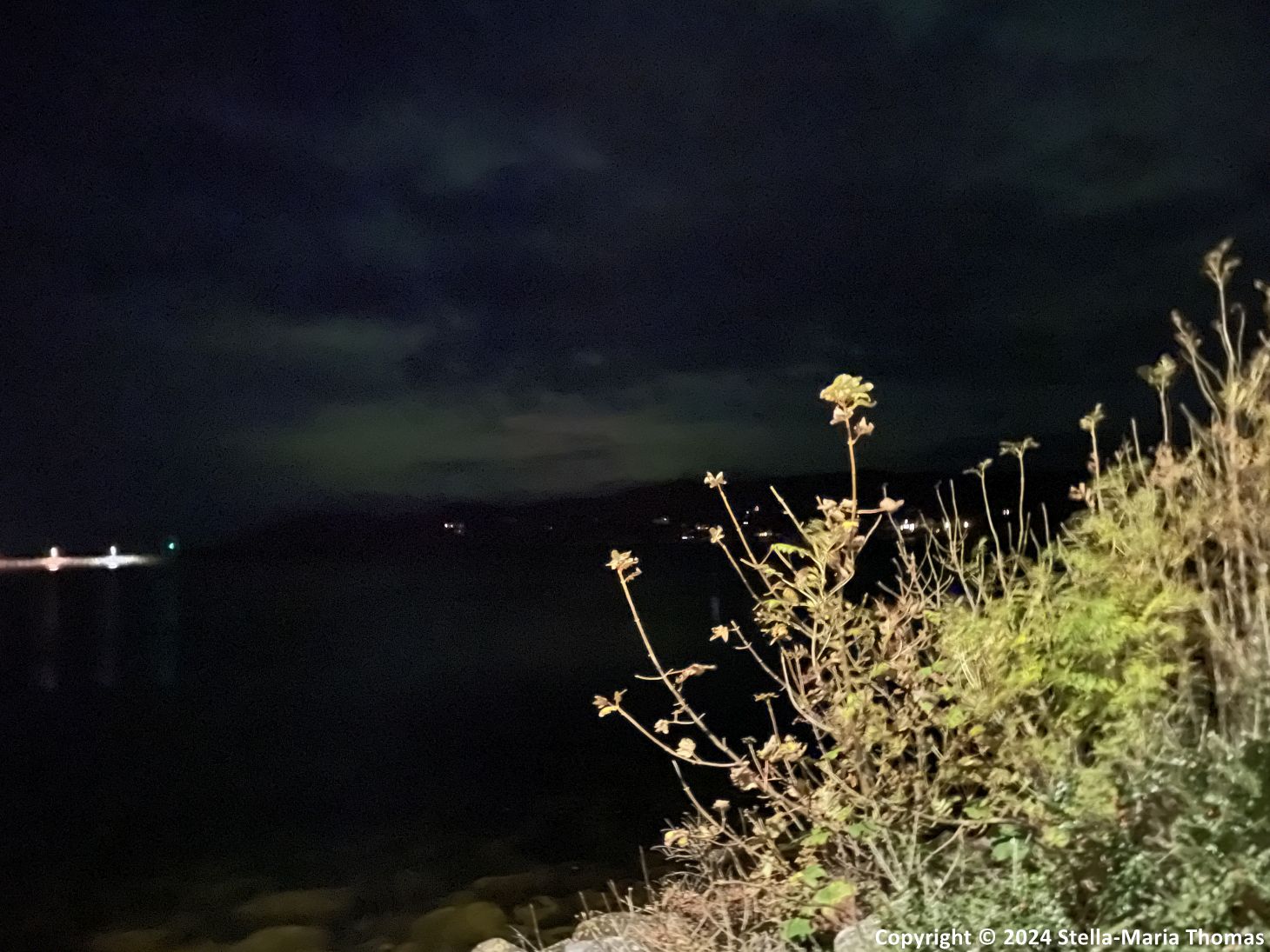
Walking back afterwards, Lochinver looked idyllic, and I even managed a faint glimpse of the aurora borealis off in the distance. Lochinver harbour was once the busiest fishing port on the West Coast, and there is still some activity. We could see the lights from the hotel next door reflecting in the water (which may have made aurora spotting that bit more difficult) and went to bed happy with our decision to stop in a place that has something of a deserved foodie reputation.

 Smtfhw's Travels
I am an expert at missing festivals by a day or two. Food looks excellent but I don’t like dog friendly pubs and restaurants.
LikeLike
I lived in France for the best part of a decade so I’m more than used to dogs in restaurants. And the one in Delilah’s lives there.
LikeLike
I am of a nervous disposition when it comes to dogs.
LikeLike